People
6Node types
Contacts · roles · positions · interviews
The Product Graph
A live slice of the production graph. 18,586 nodes. 22,903 edges. The same substrate APEX traverses · every node typed, every edge a FK constraint, every value cited.
Live slice · pyramyd-production
18,586 nodes and 22,903 edges of the real graph — vendors, products, reviews, categories, and the links between them.
~7 MB · interactive · loads on demand so this page stays fast
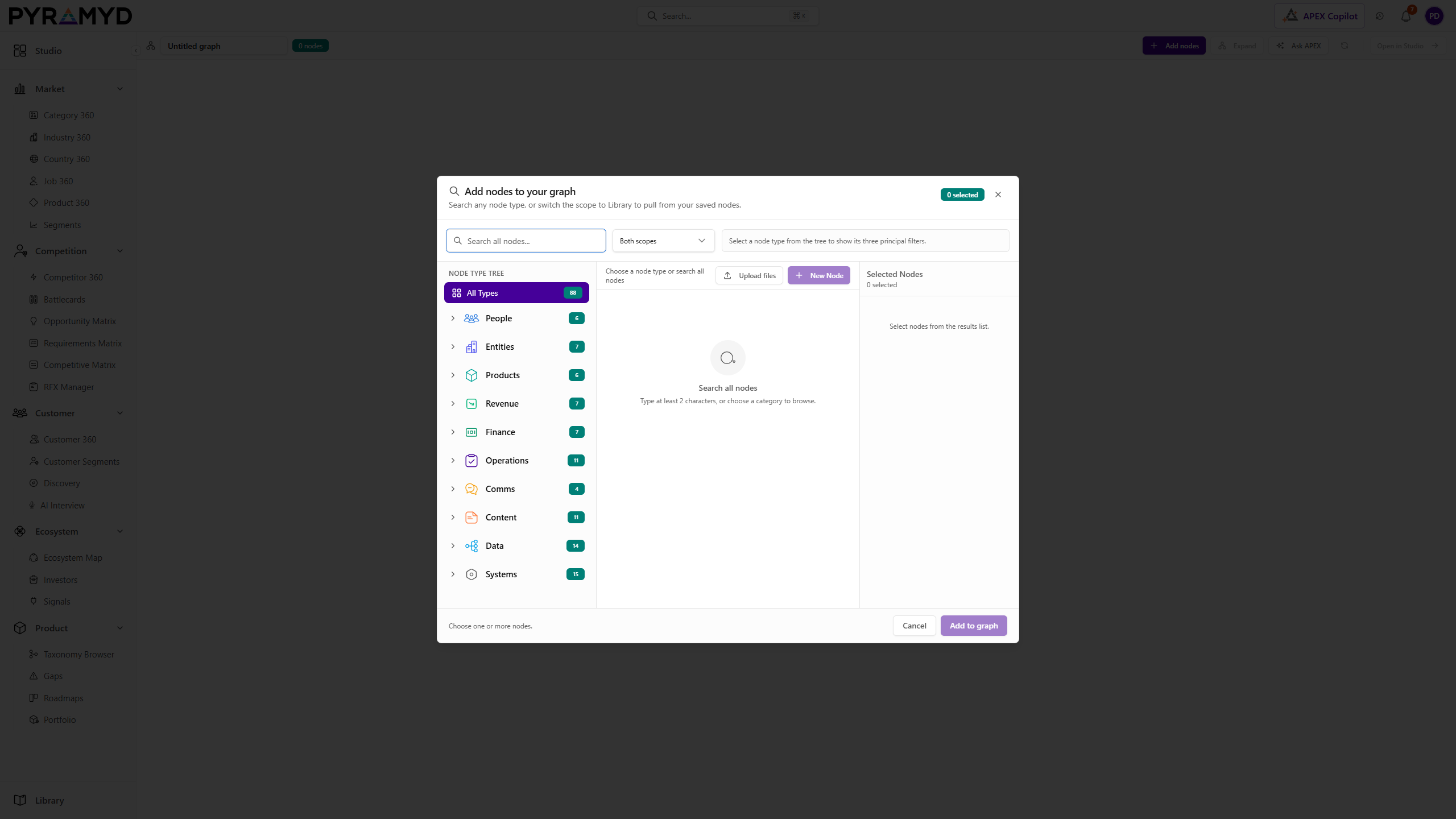
The 90 node types
The graph is heterogeneous · 90 distinct node types organized into ten categories. Each category enforces its own FK relationships, its own canonical fields, and its own provenance schema.
Node types
Contacts · roles · positions · interviews
Node types
Companies · teams · workspaces · segments · locations · countries · industries
Node types
Products · categories · features · releases · reviews
Node types
Deals · orders · pipelines · contracts · campaigns · cadences · battle cards
Node types
Transactions · postings · ledgers · periods · budgets · forecasts · filings
Node types
Ideas · requirements · issues · projects · roadmaps · cycles · objectives · capabilities · processes
Node types
Communications · chats · channels · events
Node types
Documents · articles · snippets · sheets · slides · notebooks · canvases · forms · files · folders · transcripts
Node types
Datasets · catalogs · connectors · transformations · prompts · agents · runs · models · experiments · metrics · signals · dashboards
Node types
Repositories · branches · commits · credentials · settings · activities · devices · alerts · applications · policies · services
The relationships
A node catalog is table stakes. The defensible part is the typed edges between them · expressed in two layers: hard foreign keys that the schema enforces, and a dynamic edge graph that captures the semantic relationships a column never could.
Layer 1 · Hard relationships
Deterministic, single-valued, and resolved at write time. The constrained by 2,069 declared foreign keys are these edges. Four connect to canonical entities:
company_fkbelongs to / is about a companyproduct_fkis about a productcontact_fkinvolves a personreview_fkcites a reviewThe five taxonomy FKs are special · they don't store an id and a name, they denormalize the entire ancestry, so any query filters at any level without a join:
Category
market_categoryfunctional_categoryproduct_categoryIndustry
industry_sectorindustry_groupindustrysub_industryCountry
regionsub_regioncountryJob
job_modulejob_functionjob_areajob_focusProduct
product_categorymodulecapabilityfeatureLayer 2 · Dynamic relationships
A single typed edge table makes this a true property graph · every relationship is a first-class, directed, semantic edge with 1:N multiplicity. The hard FKs are mirrored in automatically, and the full catalog is organized into ten relationship categories — each with its own icon in the workspace:
Composition
part-of / made-offeature_ofcapability_oforder_containsdataset_in_catalogHierarchy
parent / childmember_ofsubsidiary_ofpart_of_teamparent_categoryClassification
tagged / categorizedtaggedmentionsin_categoryin_industryAssociation
related / similarrelated_tocompetes_withalternative_tosimilar_toProvenance
sourced-from / evidenceauthored_byacquiredsignal_from_sourceevidence_forOwnership
owns / managesleadsmanagesassigned_toowned_by_team_assetDependency
depends-on / blocksintegrates_withdepends_onblocksrequirement_forTransaction
pays / invoicesowns_dealpaid_byinvoices_forcontract_withLifecycle
replaces / on-roadmapreplaceson_roadmapin_releaseduplicate_ofEngagement
works-at / reviewed-byworks_atreview_by_contactinterview_withparticipant_ofEach category shows a representative slice · the full catalog is 431 canonical edge types across these ten kinds, CHECK-constrained in the database so an edge is never untyped.
Typed nodes, typed edges, denormalized hierarchies · APEX traverses real relationships, not cosine similarity between text chunks. This is what “graph, not vector RAG” actually means.
How the graph is built
The same pipeline that built the graph on this page runs continuously · 2,000+ source feeds, entity-resolved, FK-linked, and provenance-stamped.
How it actually flows
Captured live in the workspace · search any of 90 node types, drop a node on the canvas, and expand its typed relationships into a connected map.
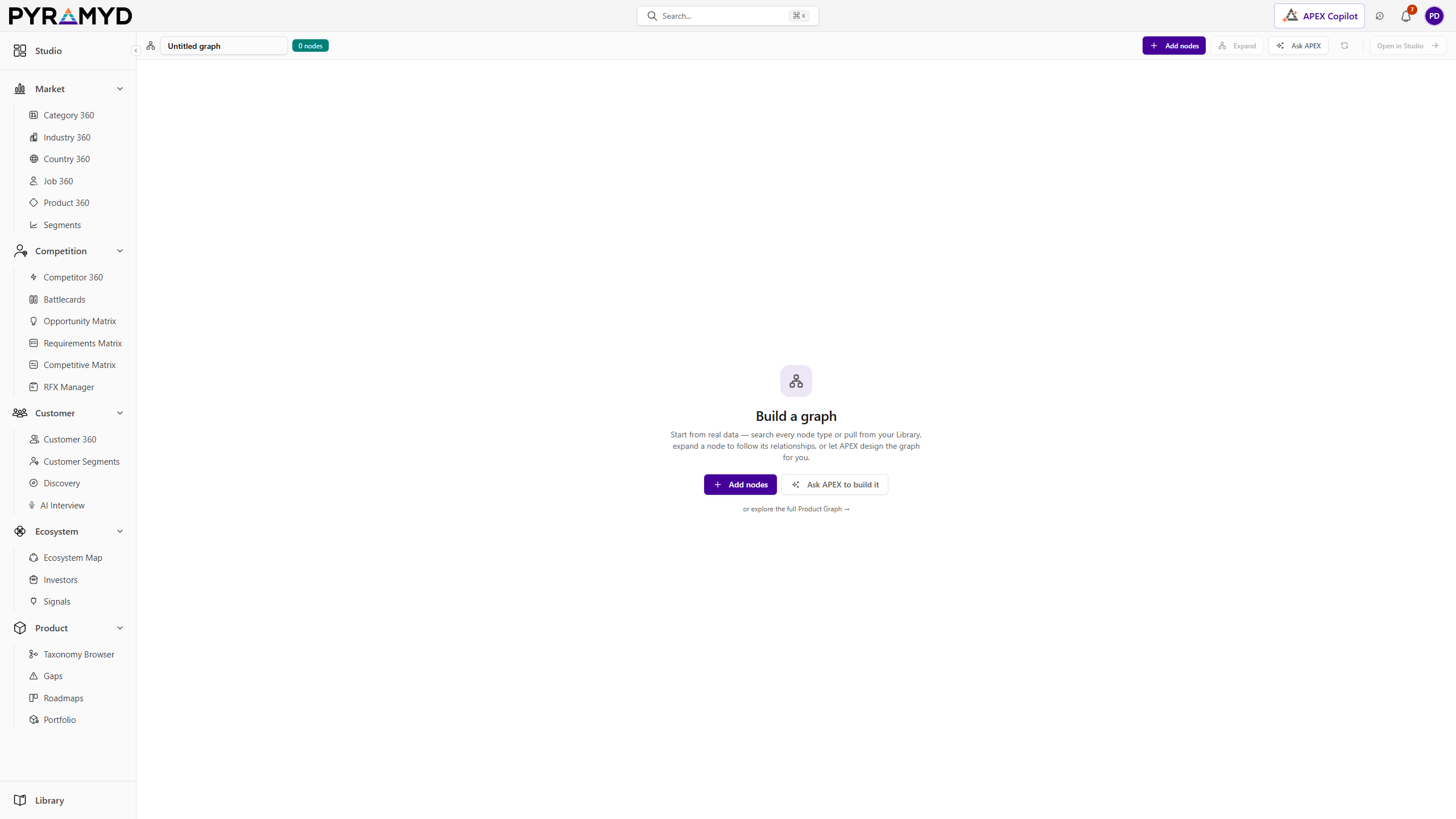
01 · Start from a blank graph
Search every node type, pull from your Library, or let APEX design the graph for you.
30 minutes. Bring a question. We'll filter the graph to your competitive set, run a multi-hop traversal in front of you, and show every cell's provenance.
Every prediction the engine makes is a traversal of the edges on this page. The graph is not a visual. It is the machine.
Where do you want to take this?
Competitive intelligence
Track every competitor without growing the CI team.
Explore
Sales & enablement
Battlecards, win/loss, and the counter-move — in the deal.
Explore
Customer teams
Churn you can see coming, with the play attached.
Explore
Product teams
Decide what to build with the market in the room.
Explore